
VO2 Max as a Longevity Marker

Cardiorespiratory fitness data in midlife women, and why it is one of the strongest predictors of longevity we have
Overview
Maximal oxygen uptake, known as VO2 max, is the physiological ceiling of the body's capacity to take up, transport and use oxygen during intense exercise. It is measured directly through a graded treadmill or cycle ergometer test, or estimated from submaximal exercise data, and it is one of the most consistently validated predictors of long-term mortality risk in the medical literature, independent of age, sex, smoking status and body weight.
Within the 3R Method, VO2 max sits under Movement and Muscle as a distinct outcome from strength and muscle mass, capturing the combined efficiency of the cardiovascular, pulmonary and musculoskeletal systems working together, and giving a woman a single, trainable number that tracks meaningfully with how long, and how well, she is likely to live.
The Mechanism
Cardiorespiratory fitness declines with age as maximal heart rate falls, stroke volume decreases and skeletal muscle oxidative capacity diminishes. In women specifically, the menopause transition compounds this age-related decline: oestrogen supports vascular function and favourable cardiac structural adaptation, and its withdrawal is associated with unfavourable structural and functional changes in the heart and vasculature that accelerate the fitness decline beyond what chronological age alone would predict.
Endurance training counters this decline through a separate and largely independent pathway: it improves cardiac output, capillary density and mitochondrial oxidative capacity in skeletal muscle. This is the biological basis for a genuinely striking finding in the literature: women who have trained consistently for years or decades can present with cardiac structure, vascular function and VO2 max on par with, or superior to, much younger sedentary women.
What the Evidence Shows
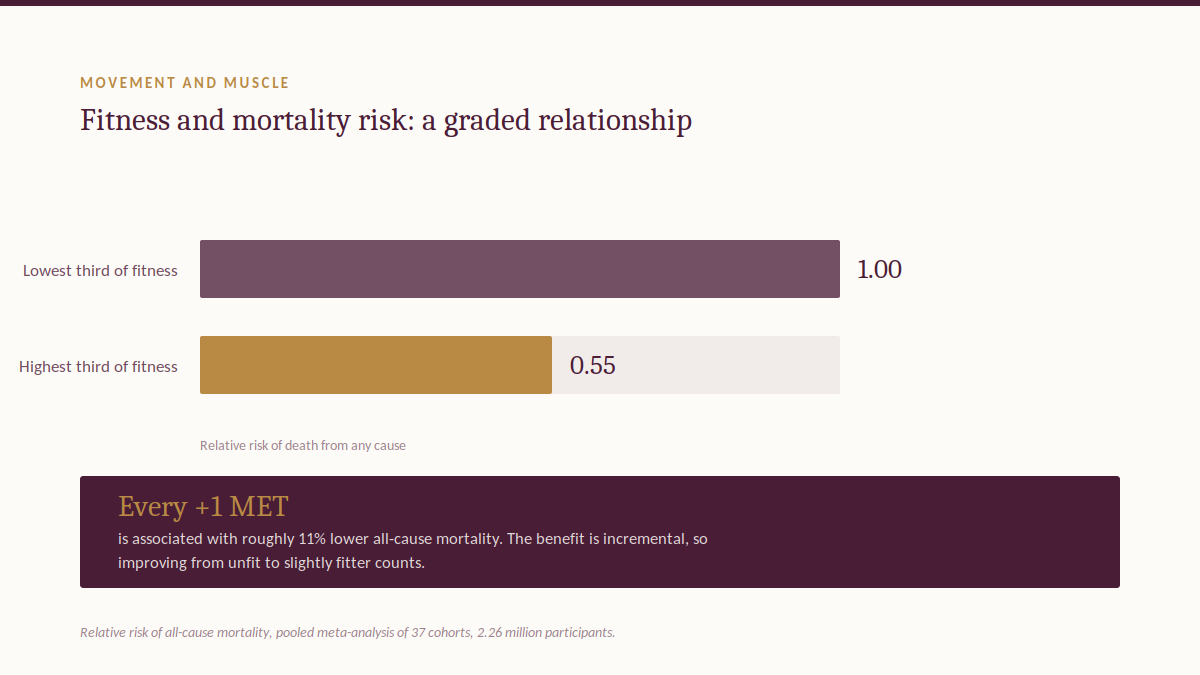
The scale of the mortality evidence for cardiorespiratory fitness is unusually large for an exercise-related biomarker. A 2022 meta-analysis pooling thirty-seven cohort studies and more than 2.2 million participants found that people in the top third of cardiorespiratory fitness had roughly half the all-cause mortality risk of those in the bottom third, a relative risk of 0.55, with an almost identical reduction when fitness was measured in metabolic equivalent units instead.
The dose-response relationship within this data is also clinically useful: each single-unit increase in metabolic equivalents of fitness has been associated with an eleven per cent reduction in all-cause mortality risk in pooled analyses, meaning even modest, incremental improvements in fitness appear to carry a measurable mortality benefit, not only reaching an elite fitness category.
Women-specific data reinforces this further. Analysis from a large cohort of women found all-cause mortality fell steeply from the least fit to the most fit quintile, and separately, a robust and independent, graded relationship has been documented between VO2 max and cardiovascular and all-cause mortality risk in women across ages, with roughly twice the mortality risk in women in the lowest fifth of treadmill exercise capacity, or those who fail to reach eighty-five per cent of their age-predicted VO2 max, compared with fitter peers.
Long-term follow-up data adds a durability dimension often missing from shorter trials. A forty-six-year follow-up study found that midlife cardiorespiratory fitness predicted all-cause and cardiovascular mortality decades later, with each unit increase in VO2 max associated with a measurable increase in longevity, and the association held even after excluding participants who died within the first ten years of follow-up, a check specifically designed to rule out the possibility that illness already present at baseline, rather than fitness itself, was driving the result.
Clinical Application within the 3R Method
Reset
Baseline fitness is assessed through submaximal estimation methods where direct treadmill testing is not accessible, giving a starting reference point before a structured aerobic programme begins.
Rebalance
A mix of moderate-intensity continuous training and, where appropriate, higher-intensity interval sessions is used to build cardiorespiratory fitness, alongside resistance training, since strength and cardiorespiratory fitness independently and jointly predict mortality risk in the wider literature.
Reclaim
Patients are supported to understand VO2 max as a genuinely modifiable marker of their own future health trajectory, reframing cardio training away from a purely aesthetic or calorie-focused activity and towards a longevity intervention with some of the strongest mortality evidence available in preventive medicine.
Summary
- VO2 max is a robust, independent predictor of all-cause and cardiovascular mortality, validated across more than 2.2 million participants in pooled cohort data.
- Each one-MET increase in cardiorespiratory fitness is associated with an eleven per cent reduction in all-cause mortality risk, showing a graded, dose-response relationship rather than a simple fit-or-unfit threshold.
- Women in the lowest fifth of treadmill exercise capacity carry roughly twice the mortality risk of fitter peers, a relationship documented specifically in women across ages.
- Midlife fitness predicts mortality risk up to forty-six years later, with the association holding after excluding early deaths to rule out reverse causation.
- Long-term endurance training can produce cardiac and vascular function in older women comparable to, or better than, much younger sedentary women, demonstrating genuine modifiability at any life stage.
References
Laukkanen JA, Isiozor NM, Kunutsor SK. Objectively Assessed Cardiorespiratory Fitness and All-Cause Mortality Risk: An Updated Meta-analysis of 37 Cohort Studies Involving 2,258,029 Participants. Mayo Clinic Proceedings, 2022.
Midlife Cardiorespiratory Fitness and the Long-Term Risk of Mortality: 46 Years of Follow-Up. Journal of the American College of Cardiology, 2018.
Effects of aging and endurance exercise training on cardiorespiratory fitness and cardiac structure and function in healthy midlife and older women. Journal of Applied Physiology, American Physiological Society.
Estimation of Cardiorespiratory Fitness Without Exercise Testing: Cross-Validation in Midlife and Older Women. PMC.
Cardiorespiratory Fitness and Longevity: The Role of VO2 max as an Indicator of Population Health. 2025.
Cardiorespiratory fitness as a quantitative predictor of all-cause mortality and cardiovascular events in healthy men and women: a meta-analysis. PubMed, 2009.