
Not All Progestogens Are Equal

The evidence differentiating body-identical and synthetic progestogens on breast cancer and clotting risk
Overview
Any woman with an intact uterus taking oestrogen therapy needs a progestogen alongside it, to protect the endometrium from the hyperplasia that unopposed oestrogen can cause. This clinical necessity is well established. What is far less consistently communicated is that not all progestogens carry the same risk profile, and that a substantial share of the breast cancer and cardiovascular signal historically attributed to hormone therapy as a category appears, on closer analysis, to relate specifically to the synthetic progestin used in the original Women's Health Initiative trial rather than to progestogens in general.
Within the 3R Method, this distinction sits at the centre of Reclaim: precise, formulation-specific knowledge replaces a single blanket verdict on hormone therapy, and allows a woman to understand that her risk depends substantially on which progestogen she is prescribed, not only on whether she takes one at all.
The Mechanism
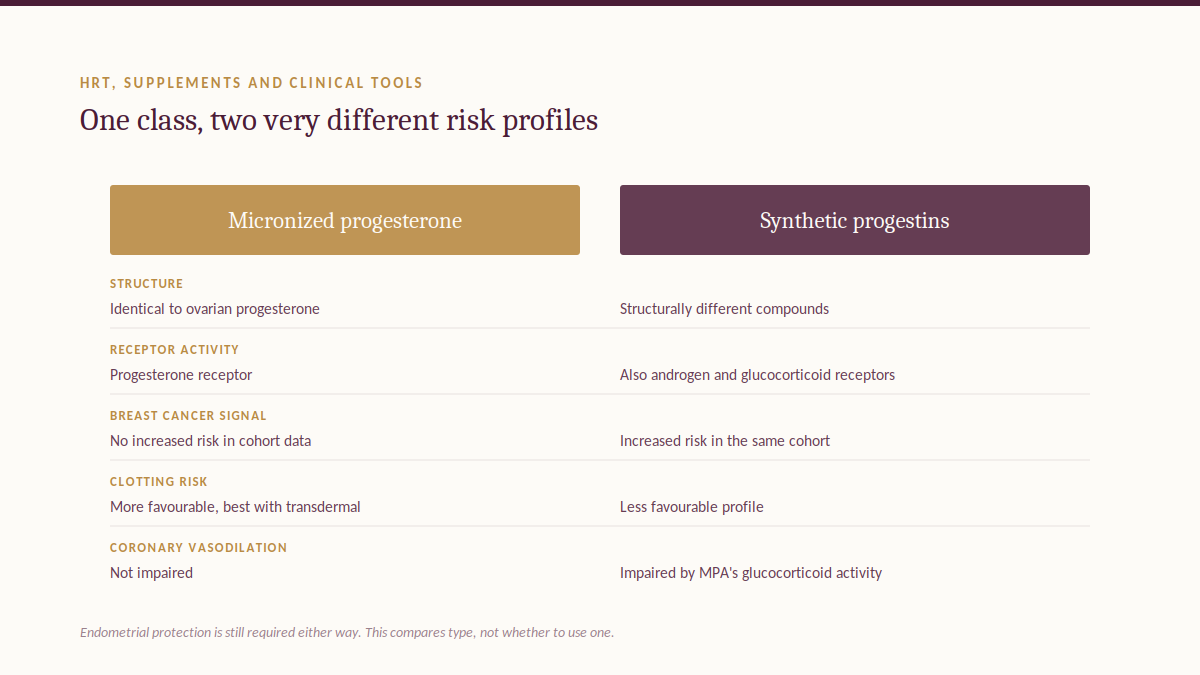
Micronized progesterone is bioidentical, meaning it is chemically identical to the progesterone the ovaries produce naturally. Synthetic progestins, including medroxyprogesterone acetate, are structurally different compounds that mimic some progesterone receptor effects but frequently also interact with androgen, glucocorticoid and mineralocorticoid receptors. This off-target receptor activity is the likely mechanistic explanation for many of the differences seen in trial and cohort data between the two classes.
Medroxyprogesterone acetate's partial glucocorticoid activity has been shown to impair coronary vasodilation in a way not observed with micronized progesterone, working against rather than alongside the vascular benefits associated with oestrogen. Micronized progesterone's metabolites, by contrast, have favourable effects on vascular tone through GABA-A receptor activity, which may also explain its commonly reported sedative benefit when dosed at night.
What the Evidence Shows
The breast cancer signal from the original WHI trial has since been reassessed with formulation specifically in mind. A large French cohort study found that breast cancer risk increased significantly for women using oestrogen combined with a progestogen overall, but when the data was separated by progestogen type, the increased risk was confined to synthetic progestins, while oestrogen combined with micronized progesterone showed no evidence of increased risk.
A systematic review and meta-analysis pooling the available comparative data found progesterone was associated with a meaningfully lower breast cancer risk than synthetic progestins when each was combined with oestrogen, though the authors noted that reassuring data currently extends mainly to the first five years of use, since most available follow-up does not extend much beyond that point.
Tissue-level research adds mechanistic weight to the epidemiological findings. A randomised trial comparing gene expression in breast tissue biopsies found that oestrogen combined with synthetic medroxyprogesterone acetate produced a different, more proliferative genetic and cellular response than oestrogen combined with micronized progesterone, offering a plausible biological explanation for the differing cancer risk signals seen in cohort data.
On clotting risk specifically, current evidence consistently favours micronized progesterone and dydrogesterone over other synthetic progestogens, with the more favourable thrombotic profile most pronounced when combined with transdermal, rather than oral, oestrogen.
Clinical Application within the 3R Method
Reset
Baseline thrombotic risk factors are reviewed before formulation choice is finalised, since route of oestrogen delivery interacts with progestogen choice in determining overall clotting risk.
Rebalance
Where a progestogen is clinically required, micronized progesterone is favoured over synthetic progestins where suitable, in combination with transdermal oestrogen, reflecting the comparative safety data on both breast cancer and venous thromboembolism risk.
Reclaim
Patients are supported to understand that the WHI headline finding was generated using one specific synthetic progestin, not progestogens as a category, correcting a common and consequential misunderstanding that has driven avoidable non-use of hormone therapy in women who could otherwise benefit from it.
Summary
- Endometrial protection with a progestogen remains necessary for any woman with a uterus taking oestrogen therapy.
- A large French cohort study found increased breast cancer risk was confined to synthetic progestins, with no evidence of increased risk for oestrogen combined with micronized progesterone.
- Meta-analysis supports a lower breast cancer risk with micronized progesterone compared with synthetic progestins when each is combined with oestrogen, with reassuring data currently limited to around five years of use.
- Tissue-level gene expression studies offer a plausible mechanism for the differing cancer risk signals between progesterone and medroxyprogesterone acetate.
- Micronized progesterone and dydrogesterone carry the most favourable venous thromboembolism profile among progestogens studied, particularly when paired with transdermal oestrogen.
References
Fournier A, et al. Unequal risks for breast cancer associated with different hormone replacement therapies: results from the E3N cohort study. International Journal of Cancer, 2005.
Asi N, Mohammed K, Haydour Q, et al. Progesterone vs. synthetic progestins and the risk of breast cancer: a systematic review and meta-analysis. Systematic Reviews, 2016.
Micronized progesterone and breast cancer risk. International Menopause Society, 2024.
The impact of micronized progesterone on breast cancer risk: a systematic review. Expert narrative review, 2018 to 2025 literature synthesis.
Effects of Estradiol/Micronized Progesterone vs. Conjugated Equine Estrogens/Medroxyprogesterone Acetate on Breast Cancer Gene Expression in Healthy Postmenopausal Women. PMC.
Not All Progesterone Is the Same: Understanding Micronized Progesterone vs. Synthetic Progestins. MyMenopauseRx.
Progesterone vs. Medroxyprogesterone Acetate. HRT University, 2026.